
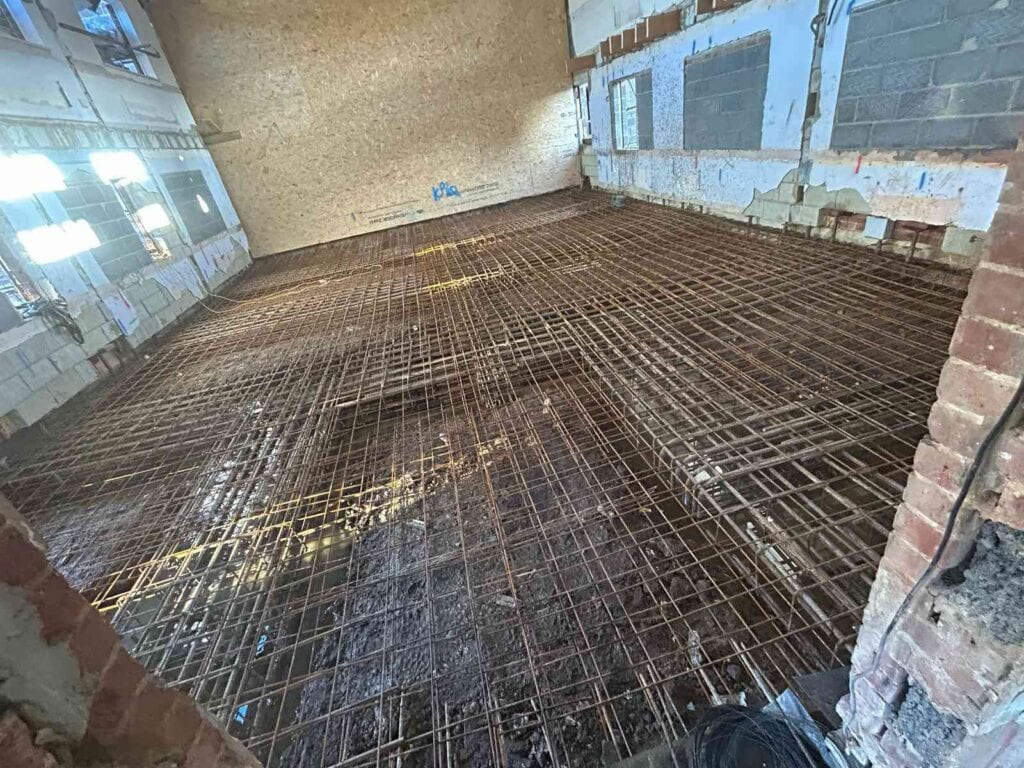
A foundation is the most critical element of any building project, as it transfers structural loads safely to the ground below. Without a properly designed foundation, even the most advanced structure is at risk of settlement and failure. Different construction projects require different foundation systems, depending on factors such as building height, load intensity, and ground conditions.
Shallow foundations are typically used for low-rise structures with lighter loads, while deep foundations are essential for taller buildings and developments constructed on weaker soil. One of the most efficient solutions for complex ground conditions is the pile raft foundation, which combines the benefits of both shallow and deep foundation systems.
In this guide, we’ll explain what a pile raft foundation is, how it works, where it is used, and its key advantages and limitations, helping you understand whether it is the right choice for your construction project.
Table of Contents
ToggleWhat is a Pile Raft Foundation?
A pile-raft foundation is a combination system that uses both piles and a foundation raft together to support a structure. Unlike traditional foundations, where either piles or a raft carries the full load, in a pile raft foundation, both elements share the load.
- Piles are long vertical structural elements made of concrete, steel, or timber. They transfer a part of the building load to deeper and stronger soil layers.
- A raft foundation is a thick reinforced concrete slab that covers the entire footprint of the building and spreads the load over a wide area.
In this system, the raft carries a significant portion of the load directly from the building, while the piles reduce settlement and provide additional load-bearing capacity. This balanced load-sharing system improves performance and safety.
Why is a Pile Raft Foundation Used?
Pile raft foundations are mainly used when the soil near the surface is weak and cannot support heavy loads alone. Instead of relying completely on deep piles, engineers combine them with a raft to make better use of soil strength and reduce construction costs.
This system is also preferred when controlling settlement is more important than increasing load capacity.
Types of Pile Raft Foundation
Pile raft foundations are classified based on their behaviour and design purposes.
Conventional Pile Raft Foundation
In this type, piles are installed below the raft to share the building load. Both piles and raft share the building load and actively support the structure. The piles reduce settlement and increase overall stability.
Settlement Reducing Pile Raft Foundation
This type focuses mainly on reducing settlement rather than carrying the entire load. The raft bears most of the load, while piles are strategically placed to control excessive or uneven settlement.
Fully piled Raft Foundation
In a fully piled raft foundation, piles carry a major portion of the load. The raft primarily distributes loads evenly and connects all piles structurally. This type is used for extremely heavy structures.
Pile Raft Foundation Process
By transferring the loads from the weak upper layer onto the stronger strata, the raft acts as a control device to help reduce the effects of differential settlement.
Site Investigation
A geotechnical survey, including deep boreholes, will show what type of soil layer exists, the level of groundwater, and the load-bearing capacities of those soils.
Load Assessment
The load placed on top of a superstructure affect how thick a raft needs to be and how much reinforcement will be required, as well as how many piles will be needed to create support for the raft.
Pile Layout Optimisation
Using soil structure interaction modelling techniques, engineers can determine the most effective location for piles.
Service Integration
Coordination of drainage, ventilation and duct systems is done on the raft and piles to ensure there are no conflicts.
Construction Sequencing
Piles are installed before raft formwork, reinforcement and concrete pouring take place.
Pile Raft Foundation Applications
High Rise Buildings
Used in tall buildings as a method of controlling total and differential settlements. They are able to distribute loads between the raft and the piles.
Soft Soil Areas
It can be used on clay, silty or loose sands where the only option for supporting the weight of a tall building is to use the raft.
Urban Construction
It is used in high-density metropolitan centres to lower construction costs through a lower number of piles.
Heavy Load Structures
Ideal for supporting large load industrial buildings, power plants and stronger tanks.
Basements and Underground Structures
For buildings that have basements, the base slab is provided by the raft, and piles are used to strengthen the structure.
Bridge Piers and Abutments
Piles and rafts are used in the construction of bridges to help manage the uneven load on weak soil.
Seismic Zones
In seismic or earthquake-prone areas, pile raft foundations allow for better redistribution of loads and increased stability.
Reclaimed Land
On filled or reclaimed land, piles give a deep anchoring point, while the raft provides a means for uniform load transfer.
Benefits of Pile Raft Foundation
Pile raft foundations offer several important benefits in construction:
- Efficient sharing of load between raft and piles
- Significant reduction in total and differential settlement
- Better use of soil bearing capacity
- Reduced the number of piles compared to traditional pile foundations
- Improved structural safety and performance
- Cost savings in large-scale construction projects
- Suitable for weak and compressible soil conditions
Cons of Pile Raft Foundation
Despite its advantages, this foundation system has some limitations:
- Design and analysis are complex
- Requires experienced geotechnical and structural engineers
- Initial design and testing costs are high
- Construction requires careful planning and supervision
- Not suitable for a light or temporary structure
- Difficult to modify once constructed
Conclusion
The pile raft foundation is a reliable and modern foundation system that combines the advantages of both piles and raft foundations. By sharing the load between the raft and piles, it improves stability and effectively controls settlement in weak soil conditions.
This foundation type is commonly used for heavy and high-rise structures where safety and durability are important. Although it requires careful design, its benefits make it a practical and efficient solution in modern construction.