
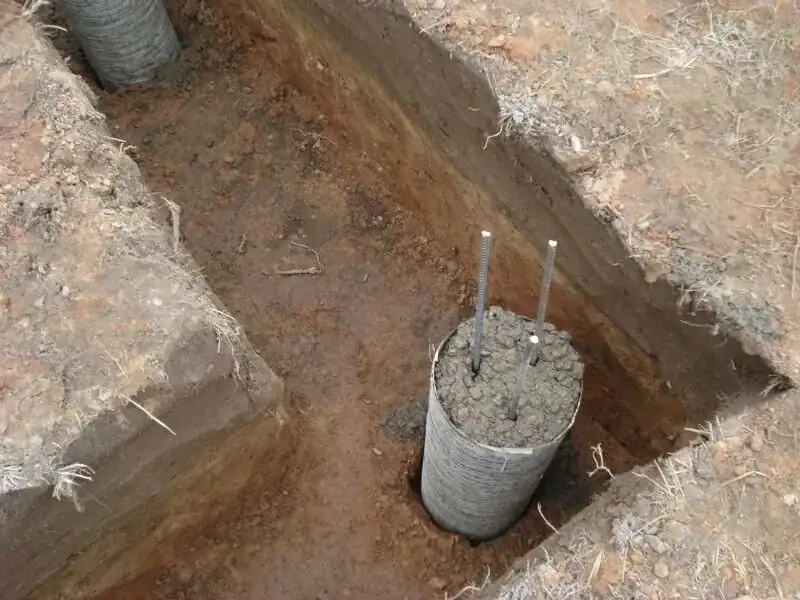
Building a new home or extension in the UK requires careful consideration of foundation depth. The minimum depth of foundations, governed by UK Building Regulations, is vital to ensure structural stability and prevent issues like frost damage or subsidence.
In this guide, we’ll cover:
- Required depths per UK Building Regulations (Approved Document A)
- How soil type, frost depth, and trees affect foundation design
- Common foundation types and their typical depths
- Expert tips for compliance and preventing structural issues
Table of Contents
ToggleWhat Do UK Building Regulations Say About Foundation Depth?
According to Approved Document A (Section 2C: Foundations), foundations must:
- Be deep enough to avoid frost damage (typically at least 450mm)
- Reach adequate bearing strata (firm soil or rock)
- Be designed to prevent movement from shrinkable clay, trees, or groundwater
While regulations do not give a fixed depth for every project, most UK foundations range between 0.9m – 1.5m depending on conditions.
Minimum Foundation Depth Requirements
The minimum foundation depth in the UK varies depending on soil type and building load. For clay soils near trees, depths typically range from 900mm to 1,500mm to counter shrinkage and swelling, while clay without trees generally requires 750mm to 1,000mm. Sandy or gravel soils, which are well-draining and less prone to frost heave, often need foundations between 600mm and 900mm, whereas chalk soils require 700mm to 1,200mm, although they should be assessed for cavities. Loam soils, known for moderate stability, also require depths of around 750mm to 1,000mm, while peat or soft soils are usually unsuitable for shallow foundations and often necessitate deep foundation solutions such as piles.
Here’s a quick comparison based on soil type and building load:
| Soil Type | Recommended Depth | Notes |
|---|---|---|
| Clay (near trees) | 900mm – 1,500mm | Deeper to counter shrinkage/swelling |
| Clay (no trees) | 750mm – 1,000mm | Standard for most builds |
| Sand/Gravel | 600mm – 900mm | Well-draining soils, less prone to frost heave |
| Chalk | 700mm – 1,200mm | Stable but needs assessment for cavities |
| Loam | 750mm – 1,000mm | Moderate stability, standard depth |
| Peat/Soft Soils | Deep foundations (piles) | Often unsuitable for shallow foundations |
Foundation Types and Depths (With Diagrams)
1. Strip Foundations (Most Common)
- Depth: Typically 600mm – 1,000mm
- Best for: Load-bearing walls, standard houses
- Diagram: (Image of strip trench foundation cross-section)
- Regulations: Must be below frost line and reach firm soil.
2. Pad Foundations
- Depth: 450mm – 750mm (site-specific)
- Best for: Supporting isolated columns or small extensions
- Notes: Soil must have good bearing capacity.
3. Raft Foundations
- Depth: 300mm – 750mm slab
- Best for: Poor or uneven soils, ground movement areas
- Advantage: Spreads load over large area to reduce settlement.
4. Pile Foundations (Deep)
- Depth: 3m+ (to firm strata)
- Best for: Weak soils (peat, silt), heavy structures
- Regulation Note: Designed by structural engineers per NHBC Standards Chapter 4.3.
Factors Affecting Foundation Depth
- Soil Type & Bearing Capacity (clay needs deeper foundations than sand)
- Frost Depth: Must be below 450mm frost line (varies regionally)
- Tree Roots: Nearby trees require deeper footings (NHBC has root distance tables)
- Building Load: Heavier structures = deeper or wider foundations
- Proximity to Existing Structures: Avoid undermining neighbours’ foundations
- Groundwater Level: High water tables may require waterproofing or piles
UK Building Regulations (Approved Document A) Key Points
- Foundations must “transmit loads safely to the ground.”
- Must be designed for soil movement (shrink/swell) from trees/clay.
- Must consider frost heave prevention (usually 450mm minimum).
- Deeper foundations (1m+) are common in clay soils or near trees.
Frequently Asked Questions (FAQ)
Q1. What is the legal minimum foundation depth in the UK?
There’s no universal figure, but 450mm is the frost line minimum, and most builds use 750mm – 1,000mm.
Q2. Do I need deeper foundations near trees?
Yes. NHBC recommends depths of 1.2m+ for clay soils near large trees.
Q3. Can I build shallower foundations for a single-storey extension?
Yes, but it must meet Building Control approval and be below frost depth.
Q4. Who decides my foundation depth?
A structural engineer or Building Control officer approves based on soil investigation and regulations.
Conclusion
Understanding minimum foundation depths per UK Building Regulations is vital to ensure safe, compliant, and long-lasting construction. Soil type, frost depth, trees, and load demands all influence foundation design.
Tip: Always seek advice from a structural engineer and involve Building Control early to avoid costly mistakes.