
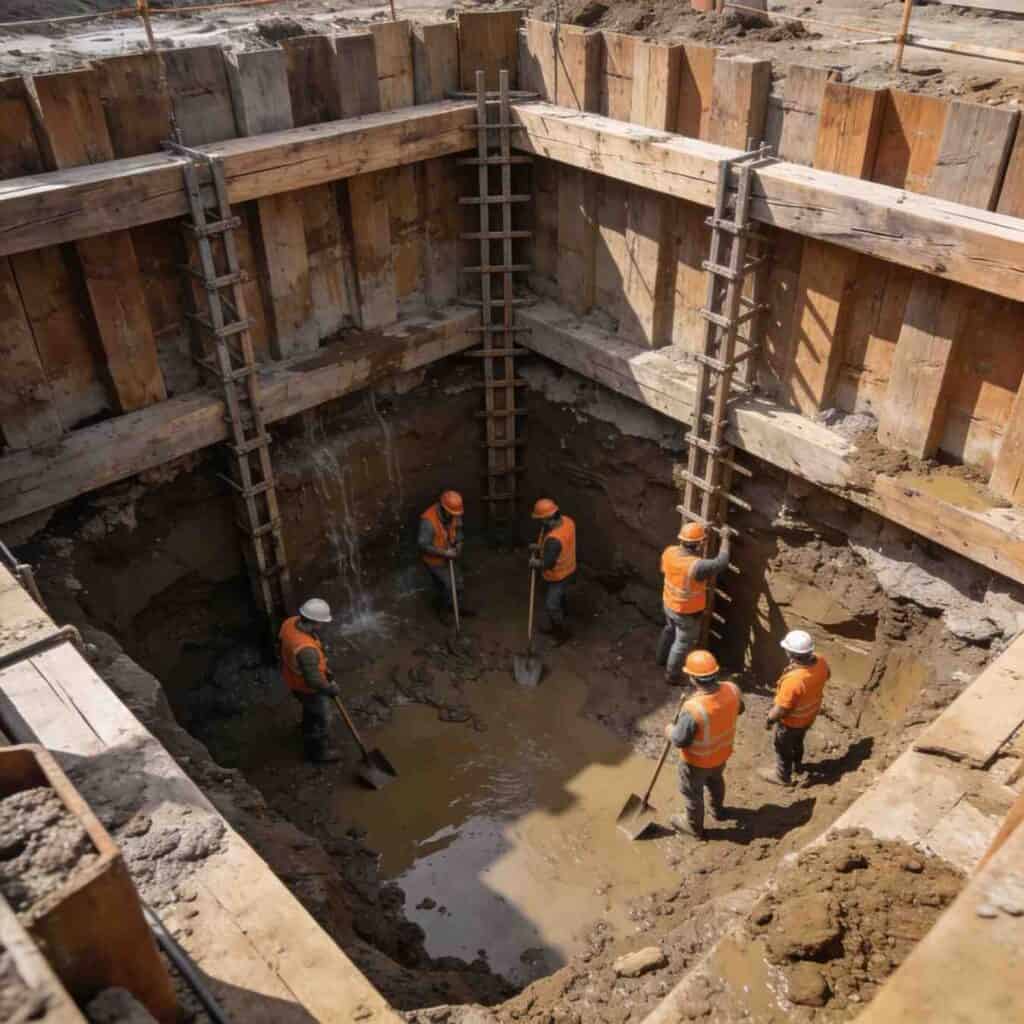
A cofferdam is a temporary watertight structure built around a construction area to hold back water and soil, allowing workers to create a dry, safe workspace for foundations, bridges, docks, dams, retaining walls, and other civil engineering projects.
A cofferdam is a temporary barrier built to exclude water and sometimes soil from a construction zone. Once installed, the water inside the enclosed area is usually pumped out, creating a dry working environment. This allows construction teams to work on foundations, piers, retaining structures, or underground elements with better control and safety.
In simple terms, a cofferdam acts like a protective box or enclosure around the work area. It resists pressure from surrounding water and ground while keeping the inside space suitable for excavation and construction.
Cofferdams can be made from several materials, including steel sheet piles, timber, earth embankments, concrete, sandbags, or cellular steel units. The type used depends on site conditions, water depth, soil type, project size, construction load, and how long the structure needs to remain in place.
A well-designed cofferdam must do more than block water. It must remain stable, resist seepage, handle ground pressure, allow safe access, and support the construction process without failing. Because, in construction, “nearly watertight” is just a dramatic way of saying “future disaster”.
Table of Contents
ToggleWhy Are Cofferdams Used?
Cofferdams are used when construction work needs to take place in or near water. Without one, workers may face flooding, unstable excavation sides, poor concrete placement conditions, and serious safety risks.
The main purpose of a cofferdam is to create a controlled construction area. This helps contractors manage water levels, ground movement, and working conditions more effectively.
Cofferdams are commonly used for:
- Bridge pier and abutment construction
- River and canal work
- Dam inspection and repair
- Marine foundation projects
- Dock, harbour and quay wall construction
- Basement or deep excavation works in wet ground
- Pipeline and drainage construction
- Flood defence and retaining wall projects
For foundation projects, cofferdams are especially useful because foundations often need to be installed below ground level, and sometimes below water level. Companies such as Southern Foundations & Pilings may work with cofferdam-related ground conditions when projects require stable access for piling, excavation, or structural support.
How Does a Cofferdam Work?
A cofferdam works by enclosing the area where construction will take place. The structure is built around the proposed work zone, usually using sheet piles or another barrier system. Once the enclosure is complete, water is pumped out from inside the cofferdam.
After dewatering, the construction team can excavate and work inside the enclosed space. Depending on the site, additional support systems may be added to stop the cofferdam walls from moving inward under external water and soil pressure.
The basic process usually includes:
- Site investigation and design
- Installation of cofferdam walls or barriers
- Sealing and bracing the structure
- Pumping water out of the enclosed area
- Excavation and construction work
- Monitoring water seepage and structural movement
- Removing or abandoning the cofferdam after completion
The design must account for water depth, flow speed, soil strength, seepage risk, excavation depth, and the forces acting on the cofferdam. A small mistake in design or installation can lead to leaks, collapse, or flooding. Construction already has enough ways to ruin everyone’s day, so cofferdam design is not something to treat casually.
Main Types of Cofferdams
Different cofferdams are used for different site conditions. There is no single design that works everywhere, because soil and water enjoy being difficult in unique ways.
Earth Cofferdams
An earth cofferdam is built using compacted soil or clay. It is often used in shallow water where the flow is slow, and the site has enough space for a wide embankment.
Earth cofferdams are relatively economical and simple to construct, but they are not suitable for deep water or strong currents. They may also need protection against erosion.
Rockfill Cofferdams
Rockfill cofferdams are made from stone, rock, or rubble. They are stronger than earth cofferdams and can resist water flow better. However, because rockfill is not naturally watertight, an impervious layer such as clay, concrete, or sheet piling is often required.
These are often used in dam and river construction where larger barriers are needed.
Sheet Pile Cofferdams
Sheet pile cofferdams are among the most common types used in modern construction. They are built by driving interlocking steel sheets into the ground to create a continuous wall.
Steel sheet piles are strong, reusable, and suitable for many soil and water conditions. They are often used for bridge piers, marine structures, retaining walls, and deep excavations.
Sheet pile cofferdams may be supported by internal bracing, walers, or tie rods, especially where water or excavation pressure is high.
Single-Wall Cofferdams
A single-wall cofferdam uses one line of sheet piles to form the enclosure. It is suitable for smaller works, shallow water, and moderate ground pressure.
This type is quicker and less expensive than more complex systems, but it has limited strength compared with double-wall or cellular cofferdams.
Double-Wall Cofferdams
A double-wall cofferdam uses two parallel sheet pile walls with the space between them filled with soil, sand, gravel, or other material. This creates a wider and stronger barrier.
Double-wall cofferdams are used for larger excavations or deeper water where a single wall would not provide enough stability.
Cellular Cofferdams
Cellular cofferdams are made from interconnected steel sheet pile cells filled with granular material. They are often used for large marine and dam projects.
They are strong, stable, and suitable for deep water, but they require careful design and installation. They are also more expensive, because apparently, the most useful construction solutions rarely come with a bargain-bin price tag.
Braced Cofferdams
Braced cofferdams use internal supports to hold the walls in place. These supports may include struts, frames, and walers. They are common in deep excavations where the pressure from water and soil is high.
Braced systems are especially useful where space is limited and external support cannot be used.
Where Are Cofferdams Commonly Used?
Cofferdams are used across civil engineering, marine construction, and foundation projects. Their role is often temporary, but their impact on the quality and safety of the final structure is significant.
Bridge Construction
Bridge piers often need to be built in rivers, lakes, or tidal areas. A cofferdam allows workers to create a dry area around each pier location, excavate safely, and construct the foundation below water level.
Dam Repairs
Cofferdams are used to isolate sections of dams for inspection, maintenance or repair. Instead of draining an entire reservoir, engineers can create a temporary dry zone around the area that needs work.
Marine and Harbour Works
Quay walls, jetties, docks and harbour structures often require cofferdams during foundation or repair works. These projects deal with tides, waves and variable ground conditions, so water control is essential.
Basement and Deep Excavation Projects
In urban areas with high groundwater levels, cofferdams or similar retaining systems may be used to keep excavations stable and dry. This is common for basements, underground car parks, and infrastructure works.
Pipeline and Drainage Works
When pipelines cross rivers, canals, or wet ground, cofferdams can isolate the working area and allow trenching, installation, and backfilling to take place under controlled conditions.
Benefits of Using a Cofferdam
Cofferdams offer several important benefits, particularly on projects where water and weak ground could cause delays, safety problems or poor workmanship.
The main benefits include:
- Creates a dry working area
- Improves worker safety
- Allows accurate excavation and foundation work
- Reduces water-related delays
- Helps control seepage and groundwater
- Supports better concrete placement
- Protects equipment and materials
- Makes inspection and repairs easier
A dry and stable work zone allows construction teams to work more precisely. This is especially important when setting out foundation levels, placing reinforcement, installing piles, or pouring concrete. Water contamination can weaken concrete quality, affect curing, and create defects, so controlling water is not just convenient. It is structurally important.
Cofferdam Design Considerations
A cofferdam must be designed according to the conditions of the site. Poor design can lead to leaks, movement, uplift, erosion, or collapse.
Important design factors include:
Water Depth and Pressure
The deeper the water, the greater the pressure acting on the cofferdam walls. Deeper water usually requires stronger materials, deeper embedment, and more bracing.
Soil Conditions
Soil type affects stability, seepage, and the ability of sheet piles or barriers to remain in place. Clay, sand, gravel, and silt all behave differently. Some soils allow water to pass through easily, while others provide better sealing.
Groundwater Level
Even if the site is not in open water, high groundwater can flood excavations. Cofferdams and dewatering systems may be needed to control water from below ground.
Water Flow and Current
Fast-moving water creates extra force on the structure and increases erosion risk. Cofferdams in rivers or tidal areas must account for changing water levels and flow direction.
Excavation Depth
The deeper the excavation inside the cofferdam, the more pressure the walls must resist. Bracing may be required to prevent inward movement.
Duration of Use
Some cofferdams are used for a few weeks, while others remain in place for months. Longer-term cofferdams need more durable materials and stronger protection against corrosion, erosion, and seepage.
Access and Safety
Workers need safe entry, exit, working platforms, and emergency routes. Pumps, monitoring systems, and ventilation may also be needed depending on the project.
Cofferdam Construction Process
The construction process varies by design, but most cofferdams follow a similar sequence.
First, engineers assess the site through surveys, ground investigations, and water condition checks. The cofferdam is then designed based on expected loads, seepage risks, and construction needs.
Next, the barrier is installed. For sheet pile cofferdams, steel sheets are driven into the ground using piling equipment. The sheets interlock to form a continuous wall. In earth or rockfill cofferdams, material is placed and compacted to create an embankment.
Once the enclosure is complete, sealing works and bracing may be added. Pumps are then used to remove water from inside the cofferdam. The area is monitored for seepage, wall movement, and base stability.
After dewatering, excavation and construction work can begin. When the permanent structure is complete, the cofferdam may be removed, dismantled, or left in place if the design allows.
Risks and Challenges of Cofferdams
Cofferdams are highly useful, but they also come with risks. Water pressure, unstable ground, and poor installation can cause serious problems.
Common challenges include:
- Leakage through joints or soil
- Wall movement or deformation
- Base heave or uplift
- Erosion around the structure
- Pump failure
- Flooding during heavy rainfall
- Unexpected ground conditions
- Safety risks during deep excavation
One major risk is seepage. Even small leaks can become serious if they wash soil away or weaken the base of the excavation. Another concern is hydrostatic pressure, which can push against the cofferdam walls or force water up through the ground.
For this reason, cofferdams require careful monitoring. Pumps, settlement checks, water level readings, and structural inspections help identify problems early.
Cofferdam vs Caisson: What is the Difference?
A cofferdam and a caisson are both used in construction involving water or deep foundations, but they are not the same.
A cofferdam is usually a temporary enclosure built around a working area. It keeps water out so construction can take place inside.
A caisson is a permanent or semi-permanent foundation structure that is sunk into place. It may become part of the final foundation system for bridges, piers, or marine structures.
So, the simple difference is this: a cofferdam protects the work area temporarily, while a caisson often forms part of the permanent structure.
Are Cofferdams Permanent?
Most cofferdams are temporary. They are built to support construction work and are removed once the permanent structure is complete. However, in some cases, parts of a cofferdam may remain in place if removal is not practical or if the design allows it.
Temporary does not mean simple, though. A cofferdam may only be needed for a limited time, but it still has to resist powerful water and soil forces. Temporary structures can still fail spectacularly if they are badly designed, because physics does not care about project deadlines.
Why Cofferdams Matter in Foundation Work
Foundations need stable ground, accurate excavation, and controlled conditions. Water makes all three harder. A cofferdam allows foundation work to be carried out with better visibility, safer access, and improved quality control.
For piling and deep foundation projects, cofferdams may help provide access to areas below water level or support excavation around foundation elements. They also help protect workers and equipment while reducing the risk of ground collapse or uncontrolled flooding.
Without cofferdams, many bridge, dock, dam, and marine projects would become slower, riskier, and more expensive.
Conclusion
A cofferdam is a temporary watertight structure used to keep water and unstable ground away from a construction area. It allows engineers and contractors to create a dry, safe, and controlled workspace for foundations, bridge piers, dam repairs, marine works, basements, and other civil engineering projects.
Cofferdams can be built from earth, rockfill, steel sheet piles, braced systems, or cellular structures. The right type depends on water depth, soil conditions, site access, project size, and the required level of stability.
Although cofferdams are temporary, their role is extremely important. They protect workers, improve construction quality, control water, and make complex projects possible in difficult environments. In short, a cofferdam is the thing that lets construction happen where water would otherwise be standing, smugly ruining everyone’s plans.
FAQs
What is the main purpose of a cofferdam?
The main purpose of a cofferdam is to keep water out of a construction area so workers can excavate, build foundations, pour concrete or repair structures in dry and controlled conditions.
Where are cofferdams used?
Cofferdams are used in bridge construction, dam repairs, docks, harbours, river works, marine foundations, basements, drainage schemes and projects where construction must take place below or near water level.
What materials are used to build a cofferdam?
Cofferdams can be built from steel sheet piles, timber, earth, clay, rockfill, concrete or cellular steel units. Steel sheet piles are commonly used because they are strong, durable and suitable for many site conditions.
Is a cofferdam a permanent structure?
Most cofferdams are temporary structures removed after construction is complete. However, some parts may remain in place if removal is difficult or if they are designed to be incorporated into the final works.
What is the difference between a cofferdam and a retaining wall?
A cofferdam is mainly used to keep water out of a temporary construction area. At the same time, a retaining wall is usually a permanent structure designed to hold back soil or support changes in ground level.