
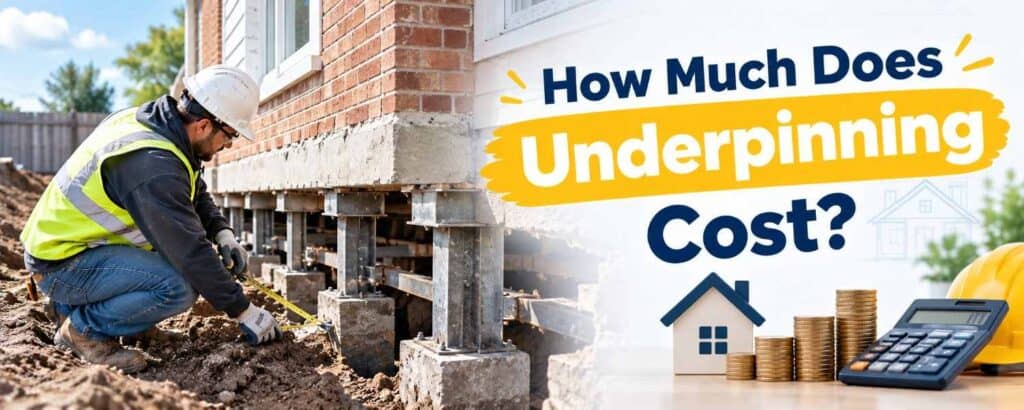
Underpinning in the UK typically costs around £6,000 to £21,000 for many residential projects, with an average cost of roughly £12,500 to £13,500. Prices can range from about £1,000 to £1,500 per linear metre for straightforward mass concrete underpinning, while mini piled or more complex systems can cost considerably more. The final price depends on the method, depth, ground conditions, access, structural design and size of the area being strengthened.
Underpinning is one of those building terms that can sound alarmingly expensive before anyone has even looked beneath the property. In reality, the cost varies significantly because underpinning is not a single standard job.
One house may require a relatively short section of traditional mass concrete underpinning. Another may have weak soil, restricted access and foundations that need to be supported using mini piles several metres below ground.
These projects cannot realistically carry the same price.
For homeowners, landlords and developers, the best way to understand underpinning costs is to look beyond one average figure and consider the method, area being strengthened, ground conditions, structural engineering requirements and additional work surrounding the project.
Table of Contents
ToggleWhat Is Underpinning?
Underpinning is a structural technique used to strengthen, deepen or stabilise the foundations of an existing building.
It may be required when the existing foundations are no longer suitable for the loads or ground conditions affecting the property.
Common reasons include:
- Subsidence
- Weak or unstable soil
- Shallow original foundations
- Changes to surrounding ground
- Major structural alterations
- Additional floors
- Basement construction
- Nearby excavation
- Changes in building loads
- Foundation deterioration
The purpose is to transfer the building’s load safely onto stronger or more stable ground.
Underpinning does not simply involve pouring additional concrete beside an existing wall. It normally requires careful excavation, temporary support, structural calculations and controlled sequencing to avoid putting the building at further risk.
Average Underpinning Cost in the UK
For a typical residential underpinning project, current UK estimates commonly place the overall cost between approximately £6,000 and £21,000, depending on the scale and method.
Recent cost guides put average residential underpinning at around £12,500 to £13,500.
A rough guide is:
Underpinning Work | Approximate UK Cost |
Small or limited underpinning project | £6,000+ |
Typical residential underpinning | £10,000 to £15,000 |
Average overall project | £12,500 to £13,500 |
Larger or complex project | £20,000+ |
Traditional underpinning | £1,000 to £1,500 per linear metre |
Beam and base underpinning | £1,500 to £2,500 per linear metre |
Mini pile underpinning | £3,000 to £5,000 per pile in some complex specifications |
Structural survey | Around £1,000 average |
These figures are budgeting guides rather than quotations. Current UK sources show substantial variation between different methods and property conditions.
Underpinning Cost Per Metre
Many homeowners search for an underpinning cost per metre because it provides a useful starting point.
Traditional mass concrete underpinning may cost roughly £1,000 to £1,500 per linear metre in many situations. Some current estimates place straightforward work at approximately £1,000 to £1,250 per metre.
However, cost per metre should be used cautiously.
For example, underpinning five metres of wall at one metre deep is very different from underpinning the same length where excavation must extend several metres down.
Two walls of identical length can therefore produce very different quotations.
Example Underpinning Costs by Property Size
Property size can influence costs, although the amount of foundation actually requiring support is more important.
Indicative current UK estimates for underpinning a single affected wall suggest figures such as:
Property Example | Approximate Cost |
2-bedroom terraced property | Around £6,000 using mass concrete |
3-bedroom semi-detached property | Around £13,500 |
4-bedroom detached property | Around £21,000 |
More specialised systems can cost considerably more. For example, mini piling on a larger property can increase the price significantly because additional equipment, piles and structural connections may be required.
These examples should not be interpreted as fixed prices for every house of that size.
What Affects the Cost of Underpinning?
Underpinning quotes are influenced by a mixture of structural, geological and practical factors.
Underpinning Method
The chosen technique is one of the biggest pricing factors.
Traditional mass concrete underpinning is usually among the more economical options where conditions allow it.
Beam and base systems require more reinforced structural work.
Mini piling may require specialist rigs, steel piles, reinforced beams and additional engineering.
The more complex the system, the higher the likely cost.
Depth of the Existing Foundations
Depth matters enormously.
If stronger ground exists only a short distance beneath the current foundation, the excavation may be relatively manageable.
Where stable strata lie much deeper, contractors may need:
- Deeper excavation
- More temporary support
- Additional labour
- More concrete
- Specialist piling equipment
Greater depth usually means higher cost.
Ground and Soil Conditions
Soil has a major influence on foundation design.
Common UK ground conditions include:
- Clay
- Sand
- Gravel
- Made ground
- Chalk
- Silt
- Mixed fill
Clay is particularly relevant because it can shrink and swell as moisture levels change.
Poor or inconsistent soil may require a more sophisticated foundation solution.
Waterlogged ground can also complicate excavation.
Size of the Affected Area
A building does not always need to be completely underpinned.
Sometimes only one wall, one corner or a specific section requires structural support.
If only four metres of wall are affected, costs may be much lower than strengthening the perimeter of an entire property.
This is why determining the actual extent of movement is critical before pricing.
Property Type
A lightweight single-storey structure can place very different loads on the ground compared with a large two or three-storey masonry house.
Factors include:
- Number of floors
- Wall construction
- Roof weight
- Extensions
- Existing foundation design
- Structural alterations
Heavier loads can require stronger underpinning systems.
Access to the Site
Restricted access can quietly become one of the biggest cost multipliers.
If machinery cannot reach the work area, excavation may need to be completed manually.
This can increase:
- Labour
- Project duration
- Waste handling
- Concrete placement costs
Properties in dense urban areas may be particularly difficult where rear access is limited.
Underpinning in London and Other High-Cost Areas
Underpinning in London and parts of the South East can cost more because labour, access and logistical expenses tend to be higher.
Properties may also be close together, making excavation and material handling more complicated.
Parking restrictions, congestion costs and limited machinery access can all influence quotations.
Types of Underpinning and Their Costs
There is no universally best method.
The appropriate system depends on the building and soil.
Mass Concrete Underpinning
Mass concrete underpinning is one of the most established techniques.
Small sections are excavated beneath the existing foundation and filled with concrete in a carefully planned sequence.
Typical budgeting figures are around £1,000 to £1,500 per linear metre, although site conditions can push the cost higher.
Best Suited For
It may be suitable where:
- Existing foundations are relatively shallow
- Stable ground is achievable at manageable depth
- Access is reasonable
- Loads are not exceptionally high
Advantages
- Well-established technique
- Relatively simple concept
- Often cheaper than piling
- Suitable for many traditional properties
Drawbacks
- Excavation intensive
- Can be disruptive
- Not ideal for very deep support
- Requires careful sequencing
Beam and Base Underpinning
Beam and base underpinning uses reinforced concrete beams supported on concrete bases.
The beam redistributes structural loads across stronger foundation points.
Typical cost planning figures can be around £1,500 to £2,500 per linear metre, although some sources price individual configurations differently.
This method may be chosen when loads need to be distributed across a broader foundation arrangement.
Mini Piled Underpinning
Mini piling transfers structural loads deeper into the ground.
Piles pass through weaker upper soils until they reach stronger material capable of supporting the building.
This approach may be necessary where:
- Stable ground lies deep below the property
- Soil conditions are poor
- Loads are substantial
- Traditional excavation is impractical
The price can vary dramatically.
Current UK guides show figures ranging from roughly £1,000 per pile for some foundation installations to £3,000 to £5,000 per pile for more involved underpinning specifications.
That difference is a good illustration of why piling should never be priced from a single headline rate.
Resin Injection
Resin injection involves injecting expanding material beneath foundations to fill voids and improve ground support.
Some UK cost estimates put this at roughly £550 per square metre, although prices vary significantly according to the system and extent of treatment.
It can be less disruptive than traditional underpinning.
However, it is not suitable for every structural problem.
A structural professional should determine whether resin injection is appropriate rather than selecting it simply because it may appear cheaper.
Structural Engineer Costs
Underpinning should be professionally designed.
A structural engineer may:
- Inspect cracking
- Assess foundation movement
- Review soil conditions
- Specify underpinning
- Produce drawings
- Carry out calculations
- Liaise with contractors
- Provide structural certification
A structural survey currently averages around £1,000 in some UK cost guides, while structural engineers may charge approximately £80 to £120 per hour depending on the service and location.
This should be factored into the total project budget.
Ground Investigation Costs
Some projects require ground investigation before foundation design can be finalised.
Tests may determine:
- Soil type
- Bearing capacity
- Moisture
- Groundwater
- Depth of stable strata
- Presence of made ground
A geotechnical investigation can add hundreds or thousands of pounds depending on its scope.
For piling projects, this information can be particularly important because pile depth depends heavily on ground conditions.
Party Wall Costs
Underpinning close to a neighbouring building may involve the Party Wall etc. Act 1996.
Where applicable, a Party Wall Agreement and surveyor involvement may be required.
Recent UK pricing estimates put Party Wall Agreement costs around £1,500 to £2,100 in some cases.
The actual amount depends on the circumstances and whether both parties appoint separate surveyors.
Building Control and Regulations
Structural foundation work normally needs to comply with Building Regulations.
Building Control may inspect stages of the work before concrete is placed.
Possible costs include:
- Application fees
- Inspection fees
- Structural drawings
- Engineer calculations
Do not treat these as optional extras when preparing a realistic budget.
Excavation and Waste Removal
Underpinning creates substantial spoil.
Soil and old foundation material must be excavated and removed safely.
Costs can rise due to:
- Skip hire
- Grab lorries
- Manual carrying
- Restricted access
- Contaminated ground
- Deep excavation
Excavation itself may also require temporary supports to maintain structural stability.
Concrete Costs
Traditional underpinning can use a substantial amount of concrete.
Price is influenced by:
- Volume
- Concrete strength
- Delivery distance
- Pumping requirements
- Access
If concrete cannot be discharged close to the excavation, a pump may be required.
Modern cost guides place concrete pump hire around several hundred pounds per day for some foundation projects.
Does Underpinning Always Fix Subsidence?
No.
Underpinning is one possible solution to subsidence, not the automatic answer.
Before underpinning is considered, the cause of movement should be identified.
Subsidence can result from:
- Tree roots
- Leaking drainage
- Shrinking clay
- Poor historic foundations
- Nearby excavation
- Changes in groundwater
Sometimes solving the cause may stabilise the building without extensive underpinning.
That is why proper diagnosis should come before structural intervention.
Signs a Property May Need Foundation Investigation
Potential warning signs include:
- Diagonal cracks near windows
- Cracks around doors
- Doors suddenly sticking
- Uneven floors
- Gaps around frames
- Cracking that increases over time
- Extensions separating from the main building
Not every crack indicates subsidence.
New plaster, thermal movement and minor settlement can also create cracks.
An engineer should assess suspicious movement rather than relying purely on appearance.
How Long Does Underpinning Take?
A typical residential underpinning project may take approximately three to six weeks, although some jobs can be shorter or considerably longer.
Current UK estimates suggest around three to five weeks for many conventional projects.
The programme depends on:
- Number of underpinning sections
- Method
- Depth
- Weather
- Ground conditions
- Access
- Inspection requirements
- Concrete curing
- Structural complexity
Mini piling may reduce some excavation but introduces specialist equipment and installation stages.
Can You Live in a House During Underpinning?
Sometimes, yes.
Occupancy depends on where the work is happening and how disruptive it becomes.
External underpinning may allow residents to remain in the house.
Internal foundation work can be much more disruptive.
Contractors may need to control:
- Dust
- Noise
- Access routes
- Excavations
- Temporary supports
Safety must take priority.
Does Home Insurance Cover Underpinning?
Home insurance may cover underpinning where it is required because of an insured subsidence event.
However, cover varies significantly between policies.
You may need to pay an excess.
Insurers may also require:
- Structural reports
- Monitoring
- Drain surveys
- Arboricultural reports
- Specialist contractors
Underpinning carried out because of renovations or increased building loads would not normally be treated the same way as insured subsidence.
Always contact the insurer before starting work if you believe subsidence may be covered.
Is Underpinning Worth the Cost?
Where underpinning is genuinely structurally necessary, avoiding it can create larger problems.
Ongoing movement may cause:
- Worsening cracks
- Distorted openings
- Structural instability
- Water ingress
- Reduced property value
- Mortgage difficulties
- Insurance complications
However, underpinning should not be carried out unnecessarily.
It is a major structural intervention.
A correct diagnosis and engineered design are essential.
Example Underpinning Budget
Imagine a property requiring six metres of relatively straightforward mass concrete underpinning.
A basic conceptual estimate might look like:
Item | Example Budget |
Underpinning works | £6,000 to £9,000 |
Structural engineer | £750 to £1,500 |
Building Control | £300 to £800 |
Waste and access costs | £500 to £1,500 |
Making good | £500 to £2,000 |
Contingency | £1,000+ |
That could result in a project approaching £9,000 to £15,000 depending on conditions.
This is only an illustration, not a quotation.
Ground conditions can change the calculation very quickly.
Hidden Costs to Include in Your Budget
Homeowners often focus only on the contractor’s underpinning price.
Other costs can include:
- Structural engineer
- Soil investigation
- Drain survey
- Party Wall surveyor
- Building Control
- Skip hire
- Temporary accommodation
- Flooring repairs
- Plastering
- Decorating
- Landscaping
- Drainage repairs
Building a contingency into the budget is sensible.
For structural work, unexpected ground conditions are not unusual.
Ways to Keep Underpinning Costs Under Control
Reducing cost should never mean reducing structural quality.
Instead, focus on planning.
Investigate First
Accurate information reduces unnecessary work.
Obtain a Proper Structural Design
Clear drawings and specifications allow contractors to quote more accurately.
Compare Like-for-Like Quotes
One contractor may include waste removal and reinstatement while another excludes them.
Improve Access Where Possible
Removing obstacles before work begins can reduce manual labour.
Address the Cause
Repair leaking drains or other causes of movement before spending money stabilising foundations.
Choosing an Underpinning Contractor
Foundation work demands specialist experience.
Look for contractors who can demonstrate experience with the proposed system.
Ask about:
- Similar projects
- Insurance
- Structural drawings
- Construction method
- Programme
- Waste removal
- Guarantees
- Building Control inspections
- Unexpected ground conditions
The cheapest quotation is not automatically the best one.
A suspiciously low price may simply exclude important work.
Specialist contractors such as Southern Foundations & Piling can assess technically demanding foundation projects and work from the structural requirements of the site rather than applying one underpinning method to every property.
Traditional Underpinning vs Mini Piling
The correct approach depends primarily on depth and soil.
Factor | Traditional Underpinning | Mini Piling |
Typical depth | Shallow to moderate | Deep |
Excavation | Significant | More localised |
Specialist equipment | Limited | Required |
Cost | Usually lower | Usually higher |
Poor ground | Limited suitability | Often suitable |
Heavy structural loads | Depends on design | Strong option |
Restricted conditions | Can be difficult | Sometimes advantageous |
Neither method is automatically better.
Structural requirements decide.
Common Underpinning Cost Mistakes
Assuming the Whole Property Needs Underpinning
Sometimes only one section has moved.
Choosing a Method by Price
The cheapest system may not suit the ground.
Ignoring Engineer Fees
Professional design should form part of the budget.
Forgetting Reinstatement
Structural work may leave damaged floors, walls or landscaping that need making good.
Using Cost Per Metre as a Final Quote
Per-metre rates are budgeting tools, not complete project prices.