
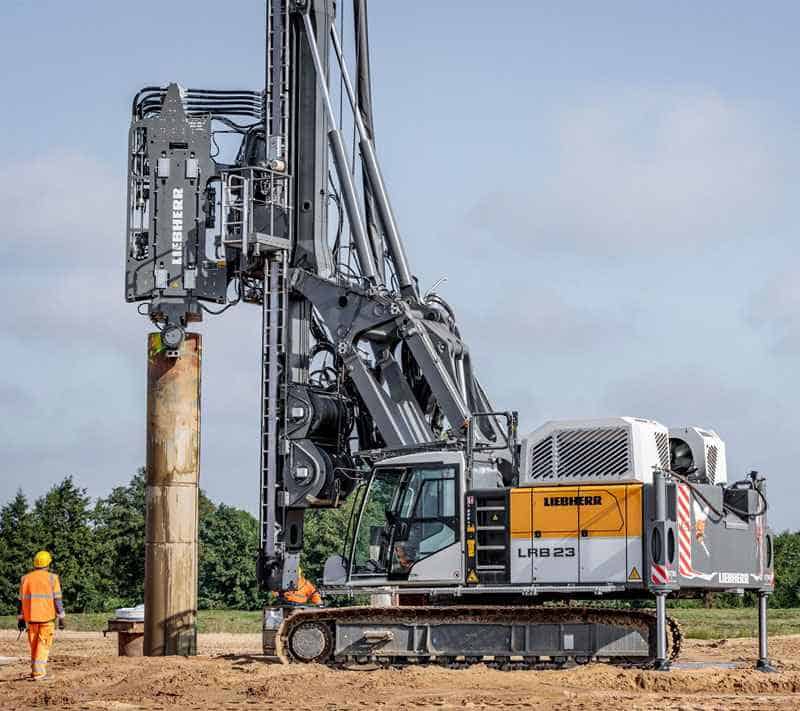
CFA piling, or Continuous Flight Auger piling, is a deep foundation method used to create strong cast-in-situ piles. A continuous hollow auger is drilled into the ground, then concrete is pumped through the auger as it is withdrawn. Reinforcement is installed into the fresh concrete to complete the pile. CFA piling offers efficient installation and relatively low vibration, making it suitable for many residential, commercial and infrastructure projects.
When a construction project requires strong foundations in challenging ground conditions, CFA piling can provide an efficient and reliable solution. But what is CFA piling, and how does it work? CFA stands for Continuous Flight Auger, a piling technique used to create deep foundations by drilling into the ground with a continuous auger before pumping concrete through the hollow centre of the auger as it is withdrawn. This method can be particularly useful for projects where speed, reduced vibration and reliable structural support are important. Specialist contractors such as Southern Foundations & Piling can assess ground conditions and foundation requirements to determine whether CFA piling is suitable for a particular development.
CFA piling, or Continuous Flight Auger piling, is a type of bored piling technique used to construct deep foundations.
The process involves drilling a continuous flight auger into the ground to the required depth. Unlike some conventional piling methods, the auger remains in the ground while drilling takes place. Once the designed depth is reached, concrete is pumped through the hollow stem of the auger as the auger is gradually withdrawn.
After the concrete has been placed, reinforcement is installed into the fresh concrete to complete the pile.
The finished pile provides a deep foundation capable of transferring structural loads into the ground.
CFA piling is widely used in construction because it can create substantial piles efficiently while producing relatively low levels of vibration compared with driven piling techniques.
Table of Contents
ToggleWhat Does CFA Stand For?
CFA stands for Continuous Flight Auger.
The name describes the equipment used during the piling process. A continuous flight auger consists of a long central shaft surrounded by helical flights, creating a large screw-like drilling tool.
The auger continuously removes or displaces soil as it penetrates the ground. Once the required depth is achieved, concrete is pumped through the hollow centre while the auger is withdrawn.
This continuous process is what gives the technique its name.
How Does CFA Piling Work?
The CFA piling process generally involves several carefully controlled stages.
1. Positioning the Piling Rig
The piling rig is positioned over the precise location where the pile is required.
The position must be carefully established because the location of each pile is determined by the structural foundation design.
2. Drilling the Auger
The continuous flight auger is rotated and pushed into the ground.
The auger continues downwards until it reaches the required depth. The helical flights help transport soil towards the surface or manage the displaced material depending on the ground conditions and piling system.
3. Reaching the Design Depth
Once the auger reaches the specified depth, drilling stops.
The depth is determined by the engineering design and information obtained from the ground investigation.
4. Pumping Concrete
Concrete is then pumped through the hollow stem of the auger.
As the auger is slowly withdrawn, concrete continuously fills the space created by the auger.
This process needs to be carefully controlled to maintain the required concrete pressure and volume.
5. Installing Reinforcement
After the concrete has been placed, reinforcement is inserted into the fresh concrete.
The reinforcement provides the required structural properties and helps the completed pile withstand the forces imposed by the building.
6. Completing the Pile
Once the concrete has reached the required level and reinforcement has been installed, the pile is prepared for connection to the wider foundation system.
The pile may eventually form part of a pile cap, ground beam or other structural arrangement depending on the project design.
Why Is CFA Piling Used?
CFA piling is used when a project requires deep foundations capable of transferring loads beyond weaker near-surface soils.
Some sites may have poor or variable ground conditions near the surface. A shallow foundation may not provide the required capacity, making a deep foundation solution more appropriate.
CFA piles can extend to deeper, stronger soil layers and provide the required support for substantial structures.
The method can also be attractive on sites where excessive vibration would be undesirable.
Benefits of CFA Piling
CFA piling can offer several advantages when properly designed and installed.
Reduced Vibration
One of the major benefits of CFA piling is that it is generally a low-vibration piling method.
Unlike driven piles, which are installed by repeatedly hammering the pile into the ground, CFA piles are formed by drilling and concrete placement.
This can make CFA piling particularly useful near existing buildings and sensitive structures where excessive vibration could cause concerns.
Efficient Installation
CFA piling can be installed efficiently because drilling and concrete placement form part of a continuous process.
Once the rig is correctly positioned, piles can often be constructed relatively quickly, depending on ground conditions and pile specifications.
This can help projects maintain their construction schedules.
Suitable for Large Projects
CFA piling can be used for a wide range of structures, including commercial buildings, residential developments and infrastructure projects.
The technique can be adapted to different pile diameters and depths according to engineering requirements.
Limited Ground Disturbance
Because the pile is constructed in situ rather than driven as a prefabricated element, CFA piling can produce less vibration than many driven-pile techniques.
This may help reduce disturbance around the construction site.
Adaptable to Different Ground Conditions
CFA piling can be suitable for various soil types, although its effectiveness depends on the specific geological conditions.
Proper site investigation is essential to determine whether CFA piling is appropriate.
Where Is CFA Piling Used?
CFA piling is commonly used in construction projects where deep foundations are required.
Commercial Buildings
Large commercial buildings often generate significant structural loads. CFA piles can form part of a deep foundation system designed to transfer these loads safely into the ground.
Residential Developments
CFA piling can be used on larger residential developments, particularly where ground conditions make conventional shallow foundations unsuitable.
Infrastructure Projects
Bridges, transport infrastructure and other major civil engineering projects may use deep foundation systems incorporating CFA piles.
Industrial Buildings
Warehouses, factories and other industrial structures can benefit from deep foundations where substantial structural loads need to be supported.
Projects Near Existing Structures
Because CFA piling generally produces lower vibration than driven piling, it can be considered for sites located close to existing buildings.
However, every project requires an individual assessment.
What Equipment Is Used for CFA Piling?
A typical CFA piling operation requires specialist equipment.
The main equipment includes:
- CFA piling rig
- Continuous flight auger
- Concrete pump
- Concrete delivery system
- Reinforcement cage
- Monitoring and control equipment
- Excavation or spoil-handling equipment
The piling rig provides the rotational force and downward pressure required to install the auger.
Concrete pumping equipment then delivers concrete through the hollow auger during extraction.
Modern piling rigs can also monitor installation parameters such as drilling depth, torque, extraction speed, concrete volume and pressure.
These records can provide useful information for quality control.
What Is the Difference Between CFA Piling and Traditional Bored Piling?
CFA piling and conventional bored piling are both types of cast-in-situ deep foundation systems, but their installation processes are different.
With conventional bored piling, a hole is drilled first and may require temporary casing or support fluid depending on ground conditions. The hole is then cleaned, reinforcement is installed and concrete is poured.
With CFA piling, the continuous auger remains in the ground while concrete is pumped through its hollow stem during extraction.
This means CFA piling can offer a faster and more continuous installation process in suitable ground conditions.
The choice between the two depends on soil conditions, pile requirements, groundwater, site constraints and engineering design.
Does CFA Piling Cause Much Noise?
CFA piling generally produces less vibration than driven piling. However, it is still a construction process involving heavy machinery, drilling and concrete operations.
Noise levels can vary depending on the equipment, soil conditions, working hours and site environment.
Where a project is located near homes, offices or other sensitive areas, contractors may need to implement appropriate noise and environmental controls.
How Deep Can CFA Piles Be?
There is no single standard depth for every CFA pile.
Pile depth depends on:
- Ground conditions
- Required load capacity
- Pile diameter
- Structural design
- Soil strength
- Groundwater conditions
- Site limitations
- Engineering requirements
A ground investigation and structural design will determine the appropriate depth and dimensions.
Is CFA Piling Suitable for Every Site?
No. Although CFA piling is a versatile foundation technique, it is not suitable for every ground condition.
Very hard ground, significant underground obstructions or particular groundwater conditions may affect whether CFA piling is practical.
For example, large buried objects can interfere with continuous auger drilling. Certain ground conditions may also require alternative piling techniques.
This is why a proper site investigation should be completed before selecting a piling method.
What Factors Affect CFA Piling Costs?
The cost of CFA piling can vary considerably from one project to another.
Factors that may influence the overall price include:
Number of Piles
A project requiring hundreds of piles will naturally have different costs from a small project requiring only a few piles.
Pile Diameter and Depth
Larger and deeper piles generally require more concrete, reinforcement, drilling time and specialist resources.
Ground Conditions
Difficult ground can affect productivity and equipment requirements.
Site Access
Restricted access can make mobilisation and installation more complicated.
Concrete and Steel Prices
The cost of materials such as concrete and reinforcement can affect the overall project budget.
Site Location
Transport, equipment mobilisation and local site conditions can also influence costs.
For an accurate estimate, a piling contractor normally needs project-specific information rather than relying on a standard price per pile.
Importance of Professional CFA Piling Design
CFA piling should always be designed and installed by appropriately qualified professionals.
The foundation needs to account for the loads imposed by the proposed structure as well as the characteristics of the ground.
Engineers may consider factors such as pile capacity, settlement, structural loads, pile spacing, reinforcement and interaction between piles.
Installation also needs to be carefully controlled to ensure the completed piles meet the design requirements.
Quality Control During CFA Piling
Quality control is an important part of the CFA piling process.
During installation, contractors may record information such as:
- Drilling depth
- Auger rotation
- Drilling torque
- Concrete volume
- Concrete pressure
- Auger extraction rate
- Pile location
- Concrete quality
Monitoring this information can help identify potential issues during construction.
Depending on the project, additional testing may also be carried out to assess the performance and integrity of completed piles.
Final Thoughts
So, what is CFA piling? CFA piling is a deep foundation technique in which a continuous flight auger is drilled into the ground before concrete is pumped through the hollow auger as it is withdrawn. Reinforcement is then installed into the fresh concrete to form a strong structural pile.
The method is widely valued for its efficient installation, relatively low vibration and ability to construct deep foundations on suitable sites. It can be used for residential, commercial, industrial and infrastructure projects where conventional shallow foundations may not provide adequate support.
However, choosing the right piling technique requires more than simply considering installation speed. Ground conditions, structural loads, pile dimensions, groundwater, site access and nearby structures all need to be assessed carefully.
With proper investigation, engineering design, installation monitoring and quality control, CFA piling can provide a reliable foundation solution for a wide range of modern construction projects.
FAQs
What is CFA piling used for?
CFA piling is used to create deep foundations for buildings and infrastructure where shallow foundations may not provide sufficient load-bearing capacity. It is commonly used for residential, commercial and industrial developments.
How does CFA piling work?
A continuous flight auger is drilled into the ground to the required depth. Concrete is then pumped through the hollow centre as the auger is withdrawn, creating a continuous concrete pile. Reinforcement is installed afterwards.
What does CFA stand for in piling?
CFA stands for Continuous Flight Auger. The term refers to the continuous helical auger used to drill into the ground and form the pile.
Is CFA piling noisy?
CFA piling produces construction noise because it involves drilling rigs, concrete pumps and other heavy equipment. However, it generally produces significantly less vibration than driven piling methods.
What are the advantages of CFA piling?
Key advantages include efficient installation, relatively low vibration, reduced disturbance and suitability for many large-scale construction projects. Its suitability still depends on the site’s ground conditions and engineering requirements.